






Speak with a licensed insurance agent

1-866-316-7339

TTY user 711 Mon-Fri : 8am-9pm EST

Dental Insurance for Seniors: Your Options When Medicare Stops at the Gums

Reviewed by Russell Noga, Licensed Insurance Agent — Last updated November 28, 2026

WHAT TO KNOW FIRST

Dental insurance for seniors is coverage you add on top of Medicare, because Original Medicare does not pay for routine cleanings, fillings, extractions, dentures or implants. The three main routes are dental benefits built into a Medicare Advantage plan, a standalone dental policy you buy on your own, or Medicaid dental if you qualify in your state.

2027 by the Numbers

47%

of Medicare beneficiaries had no dental coverage in 2019 (KFF)

98%

of individual Medicare Advantage plans offered some dental benefit in 2026 (KFF)

$874

average yearly out-of-pocket dental cost among beneficiaries who used dental care (KFF, 2018 data)

1 in 5

dental users on Medicare spent more than $1,000 out of pocket in a year (KFF)

Turning 65 often means losing the dental plan that came with a job. Medicare was never designed to replace it. KFF found that nearly half of people on Medicare, about 24 million, had no dental coverage at all in 2019, and roughly the same share went a full year without seeing a dentist. Skipped cleanings tend to turn into crowns, root canals and extractions, and those bills arrive at the stage of life when income is usually fixed.

This page is Mediplanora’s hub for dental, vision and hearing coverage after 65. It covers what Medicare pays and refuses to pay, how dental benefits inside a Medicare Advantage plan work, how a standalone senior dental policy is built, what discount plans and Medicaid can do, and the fine print to read before you sign. Vision and hearing get their own section near the end, because the same gaps apply to glasses and hearing aids.
See dental coverage options for seniors in your ZIP code

See senior dental plans from several insurance companies side by side.

Advertisement

What Medicare Pays for Dental Care, and What It Leaves to You

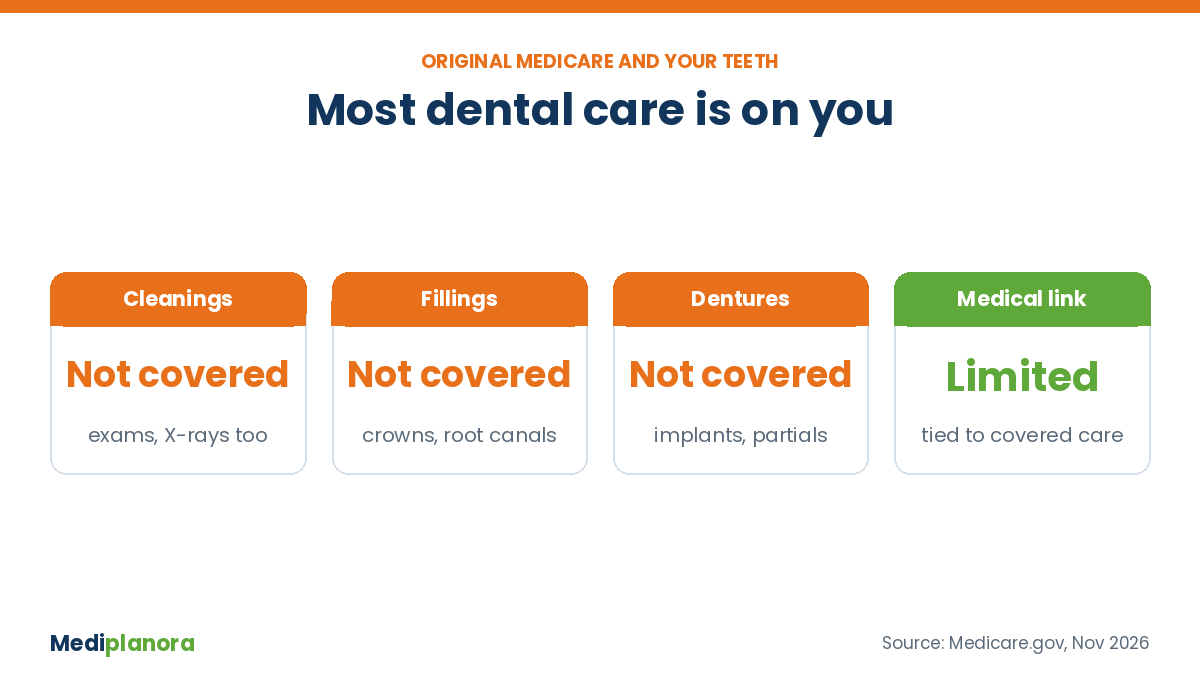
What Original Medicare covers for dental: no routine cleanings, fillings, dentures or implants; limited coverage tied to covered medical care

Medicare.gov is blunt about it: in most cases, Medicare does not cover dental services. That rules out the care most people actually need from a dentist, such as checkups, cleanings, X-rays, fillings, extractions, dentures and implants. Neither Part A nor Part B was built to pay for teeth. A Medicare Supplement plan does not change that either, since Medigap policies only help with costs for services Original Medicare already covers.

There are narrow exceptions. Medicare can pay for dental work when it is tied to a medical treatment Medicare covers. Part A can also pay for certain dental services you get while you are a hospital inpatient, when the procedure is complicated or linked to your underlying condition. For Part B-covered dental services, you generally pay 20% of the Medicare-approved amount after the Part B deductible, which is $292 in 2027.

Dental situation Does Original Medicare pay?
Routine cleaning, exam or X-rays No
Fillings, crowns, root canals No
Dentures, partials or implants No
Oral exam and treatment before a heart valve replacement or an organ, kidney or bone marrow transplant Yes, in some cases
Extraction to clear an infection before chemotherapy or radiation Yes, in some cases
Treating a dental complication during head and neck cancer treatment Yes, in some cases
Dental exams and infection treatment before and during dialysis for end-stage renal disease Yes, in some cases

Source: Medicare.gov, Dental services coverage page, reviewed November 2026.

Plain truth: If your dentist says a procedure is “medically necessary,” that alone does not make Medicare pay. The dental work has to be linked to a specific covered medical treatment, and the dentist must coordinate with the medical team. Ask for the billing plan in writing before treatment.

Three Ways Seniors Get Dental Coverage

Once you accept that Medicare will not pay for everyday dental care, the decision comes down to where your dental benefit lives. Each route has trade-offs in cost, choice of dentist and how much it pays when you need major work.

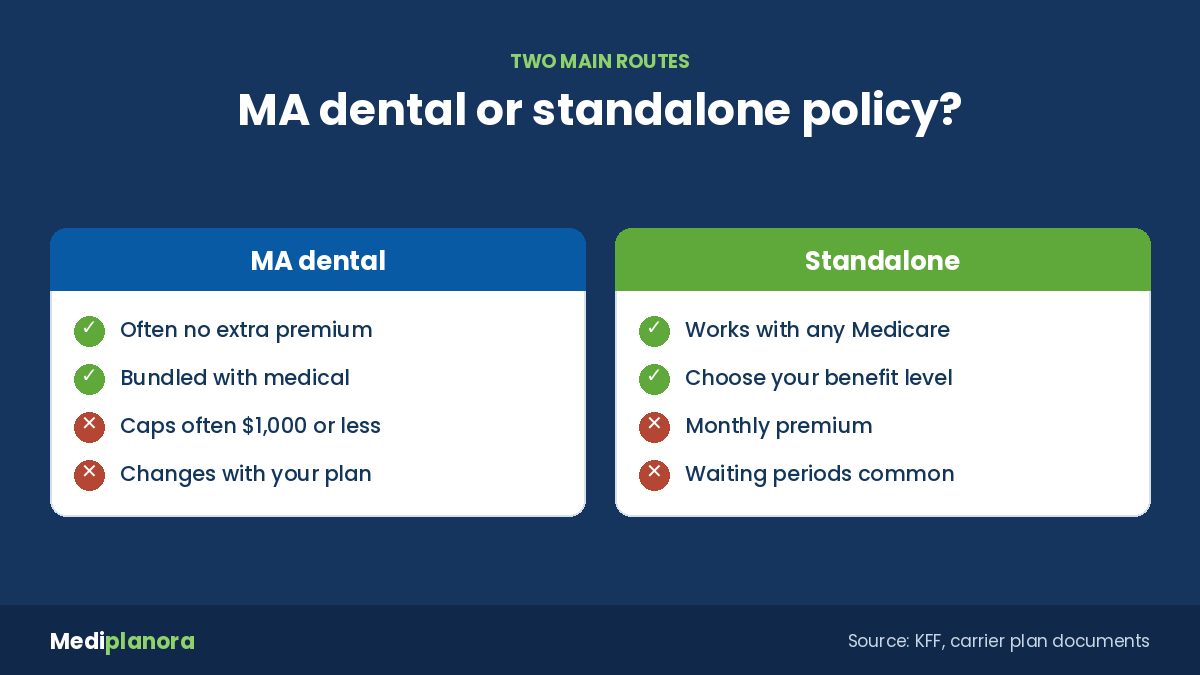
Inside a Medicare Advantage plan. Most Medicare Advantage plans include some dental benefit with no separate premium, though the amount and the network vary widely. Coverage is tied to the plan, so it can change every January.

A standalone dental policy. You buy it from a dental carrier and pay a monthly premium. It works with any kind of Medicare, including Original Medicare with a Medigap plan, and it stays in place even if you change your medical coverage.

Medicaid dental. If your income and assets qualify you for Medicaid, your state may cover some adult dental care. What adults get differs a lot from state to state, from emergency-only care to fuller benefits.

There is a fourth option many people run into: a dental discount plan. It is not insurance. You pay a membership fee and get reduced prices at participating dentists, but the plan pays nothing toward the bill itself. It can make sense as a bridge while a waiting period runs out, or for people who just want lower cleaning prices.

How Medicare Advantage Dental Benefits Work

Dental is one of the most common extra benefits in Medicare Advantage. KFF’s review of 2026 plans found that 98% of individual Medicare Advantage plans offered some dental coverage, alongside 99% offering vision and 98% offering hearing. “Offered” covers a wide range, though. Some plans cover only two cleanings and exams a year. Others add fillings, extractions, crowns and dentures, usually up to a yearly dollar cap.

READ THE DENTAL SECTION

Five things to find in the Evidence of Coverage

✓

Annual maximum. KFF’s most recent detailed look, using 2021 plans, found the average cap among plans with broader dental coverage was about $1,300, and most enrollees in capped plans had a limit of $1,000 or less.

✓

Cost sharing for major work. For services beyond preventive care, 50% coinsurance was the most common in-network arrangement KFF found.

✓

Frequency limits. Most plans limit cleanings to twice a year, and dentures are often limited to one set every several years.

✓

Network rules. HMO-style plans may require an in-network dentist. Going out of network can mean a lower benefit or none.

✓

Optional dental riders. Some plans sell a richer dental package for an added monthly premium. KFF found about one in ten enrollees paid a separate premium for any dental benefit.

For 2027, dental benefits in Medicare Advantage may include preventive care, basic and major services, or an allowance, depending on the plan and area. Not all plans offer all benefits, and the same carrier can sell very different dental packages one county apart. If dental is a major reason you are looking at Medicare Advantage, compare the dental section side by side before you compare anything else, and see our guide to Medicare Advantage vs Medicare Supplement for the medical trade-offs that come with that choice.

Compare dental, vision and hearing plans in your ZIP code

See senior dental plans from several insurance companies side by side.

Advertisement

How a Standalone Senior Dental Policy Is Built

Medicare Advantage dental benefits compared with a standalone dental insurance policy for seniors

A standalone policy is the route most often used by people who keep Original Medicare with a Medigap plan, and by Medicare Advantage members whose built-in dental is too thin. Policies differ by carrier and state, but most share the same moving parts.

THE MOVING PARTS

What decides how much a policy pays

1

Service classes. Care is usually grouped as preventive (cleanings, exams, X-rays), basic (fillings, simple extractions) and major (crowns, bridges, dentures). Preventive care tends to be paid at the highest share and major work at the lowest.

2

Deductible. Many policies have a yearly deductible before basic and major benefits start. Preventive care is often exempt.

3

Annual maximum. This is the most the policy pays in a benefit year. For reference, KFF found most ACA Marketplace dental plans had limits of about $1,000 to $2,000; senior policies often fall in a similar range, with higher-premium versions going further.

4

Waiting periods. Many policies make you wait months before basic or major services are covered. Some carriers shorten or waive the wait with proof of recent prior coverage.

5

Network. PPO-style policies let you see any dentist but pay more in network. Lower-premium HMO-style policies may limit you to a set list of dentists.

Run the math: Add up a year of premiums and compare it to the annual maximum and the work you expect. A policy that costs several hundred dollars a year and caps benefits at $1,000 pays off for a crown or a set of fillings, but not always for routine cleanings alone.

Matching Coverage to Your Mouth

The right dental coverage depends less on age and more on what your teeth need over the next two or three years. A quick honest look at your dental history usually points to the right route.

Your situation Coverage that often fits Watch out for
Healthy teeth, cleanings only Medicare Advantage preventive dental or a low-cost standalone plan Paying for a rich plan you will not use
Fillings or a crown likely soon Standalone policy with basic and major coverage, or an MA plan with comprehensive dental Waiting periods and the annual cap
Dentures or implants on the horizon Plans that clearly list prosthetics and their limits; compare caps carefully Frequency limits and missing-tooth clauses
Original Medicare + Medigap Standalone dental policy Assuming your Medigap plan covers teeth (it does not)
Low income and assets Check Medicaid and Medicare Savings Program eligibility first Adult Medicaid dental varies by state

People in treatment for a serious illness should also check how dental work fits into their medical plan. Cancer treatment, for example, can bring mouth problems that Medicare may cover only in limited cases; our cancer insurance guide explains how cash benefits can help with costs Medicare leaves behind.

Vision and Hearing: The Same Gaps

Dental is the most expensive of the three gaps, but vision and hearing follow the same pattern. Original Medicare covers medical eye and ear care, not the routine care and devices most seniors need.

Vision. Part B does not cover routine eye exams for glasses or contacts. It does cover certain medical eye care, such as glaucoma tests and diabetic retinopathy exams. After cataract surgery with an intraocular lens, Part B helps pay for one pair of glasses or one set of contact lenses, with 20% coinsurance.

Hearing. Original Medicare does not cover hearing aids or exams to fit them. Part B covers diagnostic hearing and balance exams when a provider orders them. Over-the-counter hearing aids, sold without a prescription since 2022, have lowered the price floor for people with mild to moderate hearing loss.

Medicare Advantage. Vision and hearing benefits are close to universal in individual MA plans, but most come with yearly dollar caps or frequency limits on glasses and hearing aids.

Bundled policies: Some carriers sell dental, vision and hearing together in one policy. Bundles can be convenient, but check each part’s limits separately; a generous dental maximum can sit next to a small eyewear allowance.

Fine Print to Read Before You Enroll

Dental policies look similar on a brochure and very different on a claim. These are the details that most often surprise new enrollees:

BEFORE YOU SIGN

✓

Missing-tooth clause. Some policies will not pay to replace a tooth that was already missing before the policy started.

✓

Benefit year. Find out whether the annual maximum resets on January 1 or on your policy anniversary, so you can time major work.

✓

Your dentist’s status. Call your dentist’s office and ask whether it is in the plan’s network under the exact plan name, not just the carrier.

✓

Pre-treatment estimate. For crowns, bridges or dentures, ask the dentist to send a pre-treatment estimate so you know what the plan will pay before work begins.

✓

Cancellation and rate terms. Standalone dental premiums can change. Read how and when the carrier can raise rates.

Medicare Advantage dental is also tied to your plan choice. If you change plans during the Annual Enrollment Period, which runs October 15 to December 7, your dental benefit changes with it on January 1. A standalone policy, by contrast, follows you no matter which medical plan you choose.

Putting Your Dental Plan Together

Medicare will cover your hospital stay and your doctor visits, but your teeth are mostly on you. Decide first whether your dental coverage should come from a Medicare Advantage plan or a standalone policy, then compare annual maximums, waiting periods and networks against the work you actually expect. A licensed insurance agent can line up the options sold in your ZIP code side by side.

Compare dental, vision and hearing plans in your ZIP code

See senior dental plans from several insurance companies side by side.

Advertisement

Senior Dental Coverage Questions

➤ Does Medicare cover dental insurance for seniors?

No. Original Medicare does not cover routine dental care such as cleanings, fillings, extractions, dentures or implants. It pays for dental services only in limited cases tied to covered medical treatment. Seniors usually get dental coverage through a Medicare Advantage plan, a standalone dental policy or Medicaid.

➤ Does a Medicare Supplement plan cover dental?

No. Medigap plans help pay costs for services Original Medicare covers, and because Original Medicare does not cover routine dental care, Medigap does not either. People with a Medigap plan usually add a standalone dental policy.

➤ Is dental insurance worth it after 65?

It depends on your expected dental needs and the policy’s math. Compare a year of premiums against the annual maximum and the work you are likely to need. KFF found that one in five Medicare beneficiaries who used dental care spent more than $1,000 out of pocket in a year.

➤ Can I buy dental insurance at any time?

Standalone dental policies are generally sold year-round, so you do not have to wait for a Medicare enrollment period. Dental benefits that come with a Medicare Advantage plan can only be changed when you are allowed to change that plan.

➤ Do Medicare Advantage plans cover dentures?

Some do, often with a yearly dollar cap and a limit such as one set every few years. Coverage depends on the plan and area, so check the plan’s Evidence of Coverage for prosthetics before you enroll.

➤ What is the difference between dental insurance and a dental discount plan?

Dental insurance pays part of the bill for covered services, up to an annual maximum. A discount plan is not insurance: you pay a membership fee and get lower prices from participating dentists, but you pay the whole discounted bill yourself.

➤ Does Medicaid cover dental for seniors?

It can. Every state sets its own adult dental benefits under Medicaid, from emergency care only to broader coverage. If you have both Medicare and Medicaid, ask your state Medicaid office what adult dental services are included.

➤ Are vision and hearing covered by Medicare?

Only partly. Original Medicare does not cover routine eye exams, glasses or hearing aids, with exceptions such as glasses after cataract surgery. Medicare Advantage plans commonly add vision and hearing benefits, usually with yearly limits.

Have Questions?

Speak with a licensed insurance agent

1-866-316-7339

TTY users 711

Mon-Fri: 8am-9pm ET