






Speak with a licensed insurance agent

1-866-316-7339

TTY user 711 Mon-Fri : 8am-9pm EST

Cancer Insurance: How It Pays, What It Costs and How It Fits With Medicare

Reviewed by Russell Noga, Licensed Insurance Agent — Last updated November 27, 2026

IN ONE SENTENCE

Cancer insurance is a supplemental policy that pays cash directly to you if you are diagnosed with a covered cancer, no matter what Medicare or your other coverage pays. It does not replace health coverage. It gives you money for the costs health plans leave behind, such as coinsurance, travel to treatment and bills at home.

2027 by the Numbers

2.1 million

new cancer diagnoses projected in the U.S. in 2026 (American Cancer Society)

70%

five-year relative survival for all cancers combined (ACS, people diagnosed 2015-2021)

20%

of the Medicare-approved amount you typically pay for outpatient chemo under Part B (Medicare.gov)

$292

2027 Part B deductible you meet before that 20% starts

The American Cancer Society projects about 2,114,850 new cancer diagnoses in the United States in 2026, or roughly 5,800 every day. The good news is that more people are living through it: five-year relative survival for all cancers combined has reached 70%. Longer treatment, though, often means more months of copays, coinsurance, gas, parking and lost income.

That is the gap a cancer policy is built for. This page is the starting point for everything on Mediplanora about cancer coverage. It explains the two main policy designs, what Medicare already pays for cancer care, what a policy costs, and the fine print that decides whether a claim gets paid. If you are still choosing your main coverage, start with our guide to Medicare Supplement plans, because the plan you pick there changes how much extra cash coverage you need.
Check cancer insurance options in your ZIP code

See cash-benefit cancer plans from several insurance companies side by side.

Advertisement

How a Cancer Policy Pays You

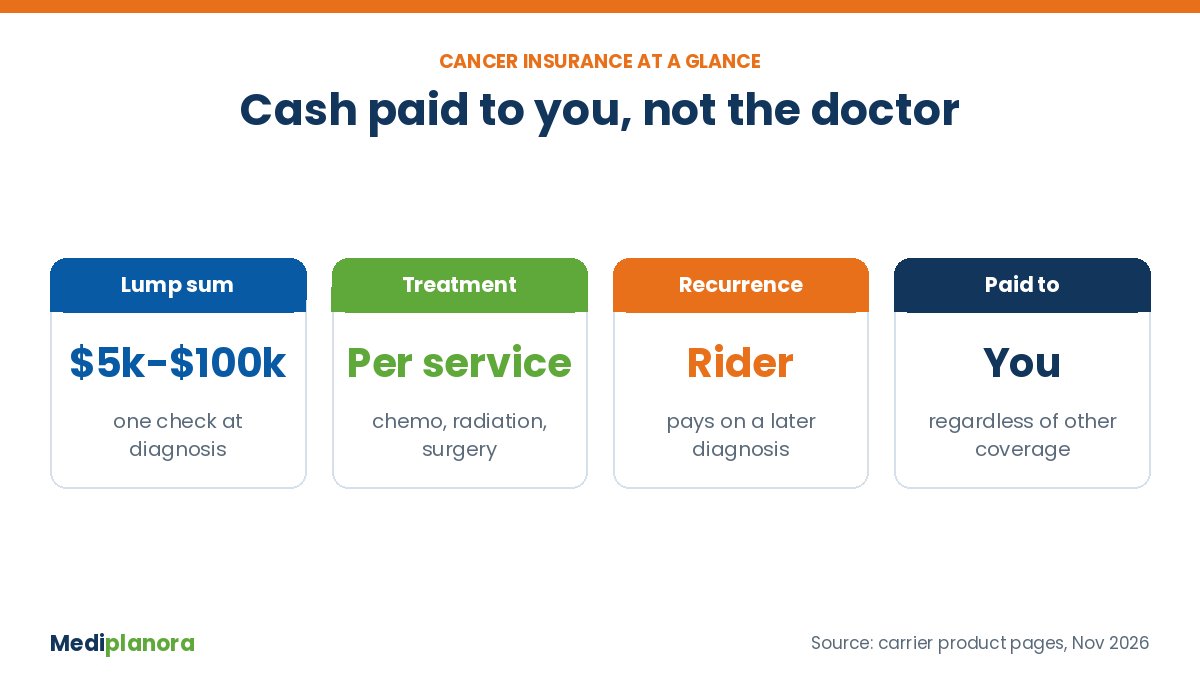
Cancer insurance at a glance: lump-sum payment, treatment benefits, recurrence riders and who receives the money

Health insurance pays doctors and hospitals. A cancer policy pays you. The money goes to the policyholder, or to someone the policyholder names, and you decide how to spend it. Some people use it for medical bills; others use it for rent, a caregiver, or a hotel near a treatment center. Most policies sold today follow one of two designs, and many carriers let you mix them with riders.

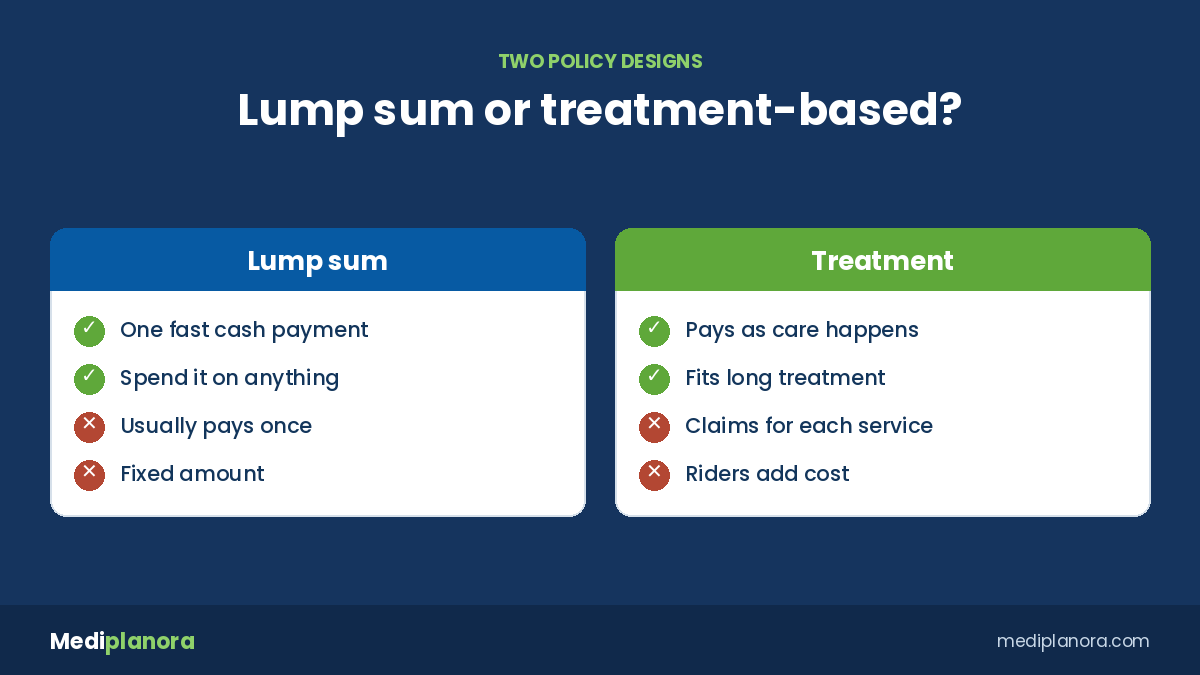
Lump-sum (diagnosis) policies. You pick a benefit amount when you apply. If you are diagnosed with a covered cancer after the waiting period, the policy pays that amount in one check. HealthSpring’s lump-sum cancer policy, for example, lets applicants choose a benefit from $5,000 to $100,000, depending on the state.

Treatment (schedule) policies. These pay set cash amounts as treatment happens: surgery, hospital stays, chemotherapy, radiation, transplants, travel and lodging, and in some cases hospice or family care. Benefits keep coming through the illness instead of all at once.

Hybrid designs. Many treatment policies offer a lump-sum rider, and many lump-sum policies offer a recurrence rider or a radiation and chemotherapy rider. Riders cost extra and are not sold in every state.

Key point: Because the check goes to you, a cancer policy pays the same whether you have Original Medicare, a Medicare Supplement, a Medicare Advantage plan or employer coverage. HealthSpring states that it pays “regardless of other insurance you may have.”

What Medicare Already Covers for Cancer, and the Bills It Leaves

Medicare covers cancer care, including chemotherapy. Part A covers chemo when you are a hospital inpatient. Medicare Part B covers it in a doctor’s office, a freestanding clinic or a hospital outpatient department. After the Part B deductible ($292 in 2027), you typically pay 20% of the Medicare-approved amount for outpatient chemo, according to Medicare.gov. Original Medicare has no yearly out-of-pocket limit, so that 20% keeps adding up for as long as treatment lasts.

Your main coverage Who pays the 20%? Where a cancer policy helps
Original Medicare only You do, with no yearly cap Coinsurance on chemo, radiation and doctor visits, plus non-medical costs
Original Medicare + Medigap Plan G Plan G pays it after the Part B deductible Mostly non-medical costs: travel, lodging, lost income, household help
Medicare Advantage plan You pay the plan’s copays or coinsurance up to the plan’s yearly out-of-pocket limit Copays until you reach the limit, out-of-network travel, non-medical costs
Part D drug plan (oral cancer drugs) You pay until the $2,400 out-of-pocket cap for 2027 Drug costs below the cap

Sources: Medicare.gov chemotherapy coverage page; CMS 2027 Part B and Part D parameters. Medicare Advantage limits vary by plan.

The table shows why the same policy can be worth more to one person than another. Someone with Original Medicare alone is exposed to open-ended coinsurance. Someone with a Medicare Advantage plan has a cap, but the cap can still be several thousand dollars, and it resets every January.

Lump-Sum vs Treatment-Based Cancer Insurance

The design you choose matters more than the brand name on the card. Here is how three real products compare, based on each carrier’s own consumer pages. Details vary by state, so always read the outline of coverage for your state.

Feature HealthSpring Lump Sum Cancer Mutual of Omaha Cancer, Heart Attack & Stroke HealthSpring Cancer Treatment
How it pays One cash payment at diagnosis One cash payment at diagnosis Cash amounts for covered treatment through the illness
Benefit range $5,000 to $100,000 $10,000 to $100,000 Schedule of benefits; optional lump-sum rider $5,000 to $100,000
Issue ages 18 to 99 (varies by state) 18 to 89 18 to 99
Also covers Optional heart attack and stroke rider Heart attack and stroke at 100%; bypass or angioplasty at 25% Optional hospital, ICU and heart attack/stroke riders
Waiting period shown See state disclosure No benefit for cancer first diagnosed within 30 days of the effective date See state disclosure

Sources: HealthSpring and Mutual of Omaha product pages, reviewed November 2026. Not available in every state.

WHICH DESIGN FITS

A quick way to decide

✓

Choose lump sum if you want simple, fast cash and plan to use it for anything from a deductible to a mortgage payment.

✓

Choose treatment-based if you expect long treatment and want benefits that keep paying as each service happens.

✓

Add a recurrence rider if you are worried about cancer coming back. HealthSpring’s version can pay up to an additional 100% on a later diagnosis once you have gone at least two years without advice or treatment.

Compare cancer insurance plans in your ZIP code

See cash-benefit cancer plans from several insurance companies side by side.

Advertisement

Who Gets the Most Value From Cancer Coverage

Lump-sum cancer insurance vs treatment-based cancer insurance compared

A cancer policy is not for everyone. It is a bet on one illness, and premiums are paid whether or not you ever claim. It tends to make the most sense when your main coverage leaves a large exposure or when a long treatment would strain your household budget.

Original Medicare without a supplement. With no cap on Part B coinsurance, a lump sum can cover months of 20% bills.

Medicare Advantage members. Your plan’s out-of-pocket limit protects you, but cash in hand can cover copays until you hit it, plus travel to a specialist outside your area.

People with a family history. Buy while you are healthy. Policies can deny or limit coverage for a cancer diagnosed before the policy starts.

Couples on one income. If one spouse becomes a full-time caregiver, a cash benefit can replace some of the lost income.

Fair warning: If you already have a Medigap plan that pays your Part B coinsurance, a large cancer policy may duplicate coverage you already pay for. A smaller benefit aimed at non-medical costs is often the better fit.

Fine Print to Check Before You Apply

BEFORE YOU SIGN

Six questions to answer first

1

Which cancers count? Many policies cover internal cancer and malignant melanoma at the full benefit and exclude pre-cancerous conditions and most skin cancers. Mutual of Omaha’s definition, for example, excludes conditions such as leukoplakia and hyperplasia.

2

Is there a waiting period? A cancer diagnosed in the first weeks after the policy starts may pay nothing. Mutual of Omaha shows a 30-day period for cancer.

3

What about carcinoma in situ? Some policies pay a partial benefit, some pay only through a rider, and some pay nothing. HealthSpring’s radiation and chemotherapy rider names carcinoma in situ.

4

Is it guaranteed renewable? Both HealthSpring cancer products are listed as guaranteed renewable for life, which means the carrier cannot cancel you for getting sick, although rates can change by class.

5

Is it sold in your state? HealthSpring’s lump-sum policy is not available in Idaho, New Mexico, New York, Virginia or Wyoming, and its treatment policy has its own list of excluded states.

6

How does a recurrence work? Without a recurrence rider, a lump-sum policy usually pays once. Check whether a second diagnosis pays and how long you must be treatment-free first.

What Cancer Insurance Costs

Premiums depend on your age, your state, tobacco use, the benefit amount and whether you cover only yourself or your family. Treatment-based policies and riders add cost. HealthSpring advertises its cancer treatment policy from around $18 a month, as an example rate that will not fit everyone.

Sample quote: Dallas, TX, woman age 58, no tobacco $10,000 individual $25,000 family
Mutual of Omaha $11.08/mo $69.21/mo
Aetna $20.83/mo $100.87/mo
HealthSpring $21.00/mo $95.00/mo

Live quotes pulled by Mediplanora’s quoting tool in November 2026 for ZIP 75201. Your rate will differ; rates change and vary by age, state and options.

Two takeaways from those numbers. First, the spread between carriers for the same benefit can be close to double, so comparing more than one company is worth the few minutes it takes. Second, family coverage costs several times more than individual coverage, so price out both before assuming you need everyone on one policy.

Cancer Insurance With Medigap or Medicare Advantage

Your main Medicare choice sets how much cancer cash you need. A Medigap plan such as Plan G leaves very little medical cost after the Part B deductible, so the cancer policy mostly covers life costs. A Medicare Advantage plan has lower premiums but copays and coinsurance up to a yearly limit, which can make a cancer benefit sized close to that limit a practical pairing. Our side-by-side look at Medicare Advantage vs Medicare Supplement walks through that trade-off in more detail.

Timing tip: Cancer policies are medically underwritten in most cases, unlike Medigap during your open enrollment window. Apply before any symptoms or tests are pending, because questions about recent tests or pending diagnoses can lead to a decline.

The Takeaway

Cancer insurance is cash for the costs that come with a diagnosis, paid to you on top of whatever Medicare covers. Size it to the gap your main coverage leaves, read the definition of cancer and the waiting period before you buy, and compare at least two carriers, because prices for the same benefit can differ widely.

Compare cancer insurance plans in your ZIP code

See cash-benefit cancer plans from several insurance companies side by side.

Advertisement

Cancer Insurance Questions

➤ Does Medicare cover cancer treatment?

Yes. Medicare covers chemotherapy, radiation, surgery and related care. Part A covers inpatient care and Part B covers outpatient care, where you typically pay 20% of the approved amount after the Part B deductible.

➤ Can I buy cancer insurance if I am on Medicare?

Yes. Cancer policies are sold separately from Medicare and pay you directly, so they work alongside Original Medicare, a Medigap plan or a Medicare Advantage plan. Issue ages vary: Mutual of Omaha’s cancer, heart attack and stroke policy is sold to ages 18 to 89, and HealthSpring’s cancer policies to ages 18 to 99 depending on the state.

➤ Can I get cancer insurance after a cancer diagnosis?

It is difficult. Most policies ask about past cancer and can decline or limit coverage for a condition diagnosed before the policy starts. The time to buy is while you are healthy.

➤ How much cancer insurance should I buy?

Start with the gap in your main coverage. If you have a Medicare Advantage plan, many people look at a benefit near the plan’s yearly out-of-pocket limit plus a cushion for travel and household costs. With a Medigap plan that pays coinsurance, a smaller benefit is often enough.

➤ Does cancer insurance cover skin cancer?

Usually not at the full benefit. Many policies define covered cancer as internal cancer or malignant melanoma and exclude other skin cancers and pre-cancerous conditions. Read the policy’s definition before you apply.

➤ Is there a waiting period on cancer insurance?

Often, yes. Mutual of Omaha, for example, pays no benefit for cancer first diagnosed within 30 days of the policy’s effective date. Waiting periods differ by carrier and state.

➤ Will cancer insurance pay if the cancer comes back?

Only if the policy or a rider covers recurrence. A lump-sum policy without a recurrence rider typically pays once. HealthSpring’s recurrence rider can pay up to an additional 100% after at least two years without advice or treatment.

➤ Is cancer insurance worth it with a Medigap plan?

It can be, but mostly for non-medical costs. Plan G already pays the 20% Part B coinsurance after the deductible, so a large cancer benefit may duplicate coverage. A smaller policy aimed at travel, lodging and lost income is a more common fit.

Weighing your options? Cancer insurance vs critical illness compares what each policy pays for and the age limits that matter once you are on Medicare.

Have Questions?

Speak with a licensed insurance agent

1-866-316-7339

TTY users 711

Mon-Fri: 8am-9pm ET