






Speak with a licensed insurance agent

1-866-316-7339

TTY user 711 Mon-Fri : 8am-9pm EST

Medicare Plan N Excess Charges: What They Cost, When They Happen and the 8 States That Ban Them

Reviewed by Russell Noga, Licensed Medicare Insurance Broker (all 50 states) — Last updated November 26, 2026

THE SHORT ANSWER

Plan N does not pay Part B excess charges, which are extra fees of up to 15% above the Medicare-approved amount that a doctor who does not accept Medicare assignment can bill you. They are uncommon, they are banned in eight states, and you can avoid them by using doctors who accept assignment, so for many people they are a small risk next to Plan N’s lower premium.

2027 by the Numbers

15%

most a non-participating doctor can charge above the Medicare-approved amount

8

states that ban Part B excess charges

$292

2027 Part B deductible, also not paid by Plan N (CMS)

Medicare Supplement Plan N is popular because it costs less each month than Plan G while covering almost the same things. The trade-offs are small copays, the Part B deductible and one gap that worries a lot of shoppers: Part B excess charges.

This page explains exactly what an excess charge is, how to work out what one would cost you, where they are illegal and how to make sure you never see one. If you are still choosing a plan, our Medicare Supplement plans guide compares every plan letter.
Compare Plan N and Plan G rates in your ZIP code

See Plan G, Plan N and more from several insurance companies.

Advertisement

What a Part B Excess Charge Is

Doctors who treat Medicare patients fall into three groups. Most are participating providers who always accept the Medicare-approved amount as payment in full. A smaller group does not accept assignment on every claim. A very small group opts out of Medicare entirely.

Type of provider What you can be billed Does Plan N pay the extra?
Participating (accepts assignment) Only the Medicare-approved amount Nothing extra to pay
Non-participating (does not accept assignment) Up to 15% above the Medicare-approved amount No — this is the excess charge
Opted out of Medicare Whatever you agree to in a private contract No — Medicare and Medigap pay nothing

The 15% cap is called the limiting charge. It applies to Part B services such as doctor visits and outpatient care.

Worth knowing: Excess charges only apply to Part B services. Hospital stays under Part A never carry an excess charge.

How Much an Excess Charge Can Cost You

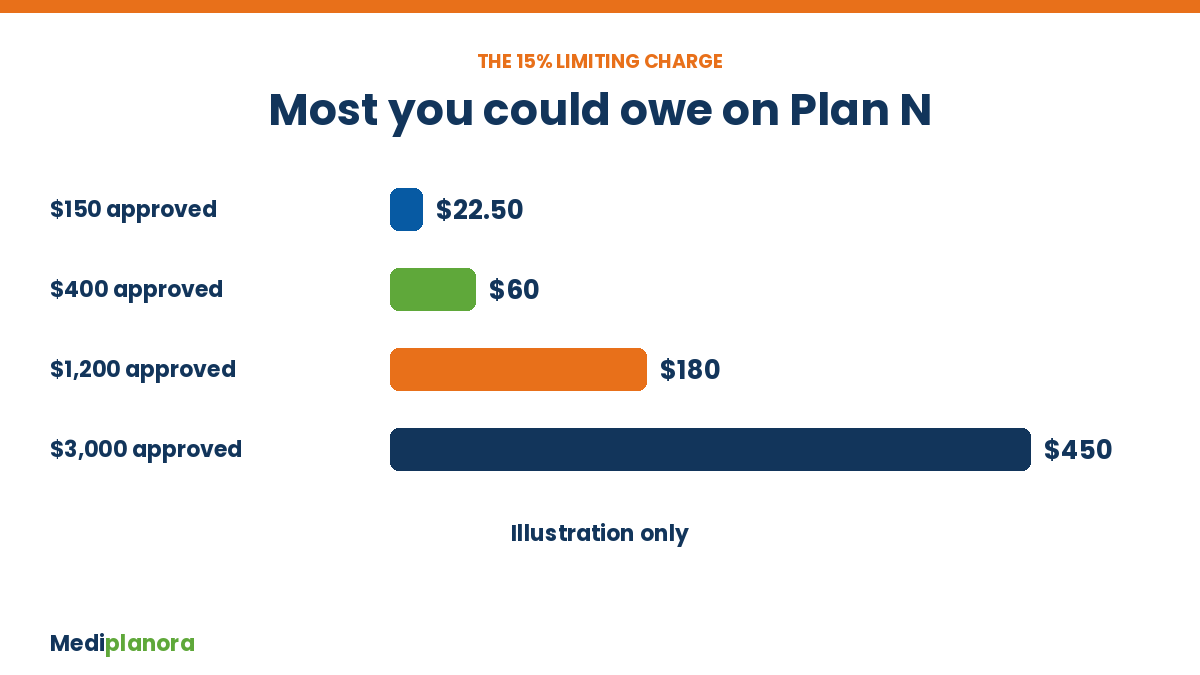
Medicare Plan N excess charges: the most a non-participating doctor can charge at 15% above the Medicare-approved amount

The math is simple: take the Medicare-approved amount for the service and multiply by up to 15%. That amount is yours to pay on Plan N, on top of any Plan N copay.

Medicare-approved amount Most the excess charge can be Example service
$150 $22.50 Specialist office visit
$400 $60 Imaging or a minor procedure
$1,200 $180 Outpatient surgery fee
$3,000 $450 A larger outpatient procedure

Illustration only. Medicare-approved amounts vary by service and location.

Because the limiting charge is capped, an excess charge cannot become an open-ended bill. The bigger risk is a costly procedure with a doctor who does not accept assignment, which is why the next sections matter.

The 8 States Where Excess Charges Are Banned

NO EXCESS CHARGES ALLOWED

If you live here, Plan N’s gap mostly disappears

✓

Connecticut

✓

Massachusetts

✓

Minnesota (protects residents; out-of-state patients at Minnesota facilities can still be billed)

✓

New York

✓

Ohio

✓

Pennsylvania

✓

Rhode Island

✓

Vermont

These protections apply to care you get in that state. If you live in one of them but travel for care, for example to a specialist in another state, an excess charge can still apply there. Massachusetts and Minnesota also use their own Medigap plan designs instead of the standard plan letters.

Compare Medicare Supplement rates in your ZIP code

See Plan G, Plan N and more from several insurance companies.

Advertisement

How to Avoid Excess Charges on Plan N

FIVE HABITS

Keep your Plan N bills predictable

1

Ask one question when you book. Ask the office: do you accept Medicare assignment? If the answer is yes, there is no excess charge.

2

Check before major procedures. Surgeons, anesthesiologists and imaging centers can bill separately, so ask each one.

3

Use Medicare’s Care Compare tool. It shows whether a doctor accepts assignment.

4

Read the Medicare Summary Notice. It shows the approved amount and any amount above it, so you can question a charge.

5

Keep receipts for the copays. Plan N copays are up to $20 for some office visits and up to $50 for an emergency room visit that does not lead to an admission.

Plan N vs Plan G: Is the Excess Charge Gap Worth the Savings?

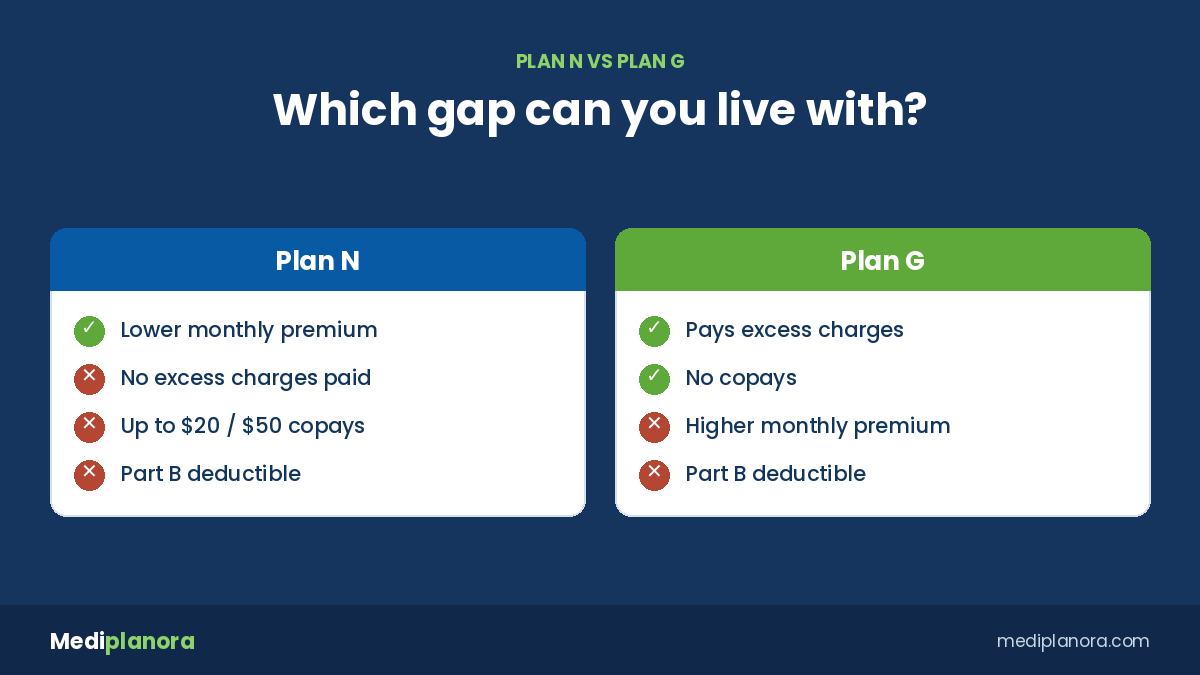
Plan N vs Plan G: excess charges, copays and monthly premium compared

Plan G pays excess charges. Plan N does not, and also leaves you the copays. In return, Plan N usually costs less every month. The question is whether the yearly premium savings outweigh what you might pay out of pocket.

New Jersey example, man age 65 Plan G Plan N
Lowest monthly premium (Sept 2026 chart) $164.31 $119.90
Highest monthly premium (Sept 2026 chart) $299.88 $200.84
Yearly savings with Plan N at the lowest rates — $532.92
Pays Part B excess charges Yes No
Office and ER copays No Yes

Source: New Jersey Division of Aging Services Medigap rate chart, September 2026. Your state, age and insurance company will give different prices.

Plan N often fits if: you see your doctors a few times a year, they accept assignment, and you would rather keep the premium difference.

Plan G often fits if: you see many specialists, travel for care, or live where non-participating doctors are common and want no surprises at all.

What Plan N Covers in 2027

Apart from the gaps above, Plan N covers the same core costs as Plan G, including the 2027 Part A hospital deductible of $1,776, Part B coinsurance after the $292 Part B deductible, skilled nursing coinsurance and foreign travel emergency care up to plan limits. Like every Medicare Supplement plan sold today, it does not cover prescriptions, so most people pair it with a Part D drug plan.

Thinking about a Medicare Advantage plan instead? Our Medicare Advantage vs Medicare Supplement comparison explains the trade-offs and the switching rules.

The Bottom Line on Plan N Excess Charges

Plan N’s excess charge gap is real but limited: no more than 15% above the Medicare-approved amount, banned in eight states, and avoidable by choosing doctors who accept assignment. For many people the monthly savings over Plan G are worth it. Compare both in your ZIP code before you decide.

Compare Medicare Supplement rates in your ZIP code

See Plan G, Plan N and more from several insurance companies.

Advertisement

Plan N Excess Charge Questions

➤ Does Medicare Plan N cover excess charges?

No. Plan N does not pay Part B excess charges. Plans G and F are the Medicare Supplement plans that cover them.

➤ How common are Part B excess charges?

They are uncommon because most doctors who treat Medicare patients accept assignment. They show up mainly with doctors who do not accept assignment on a given claim.

➤ What is the most a doctor can charge above Medicare?

A non-participating doctor can charge up to 15% above the Medicare-approved amount for a Part B service. This cap is called the limiting charge.

➤ Which states do not allow excess charges?

Connecticut, Massachusetts, Minnesota, New York, Ohio, Pennsylvania, Rhode Island and Vermont ban Part B excess charges for care in those states.

➤ Do excess charges count toward the Part B deductible?

No. Excess charges do not count toward your Part B deductible, which is $292 in 2027.

➤ Can I switch from Plan N to Plan G later?

You can apply, but outside your Medigap open enrollment period most states let insurance companies ask health questions, so approval is not guaranteed.

➤ What copays does Plan N have?

Plan N has copays of up to $20 for some office visits and up to $50 for emergency room visits that do not result in an inpatient admission.

Have Questions?

Speak with a licensed insurance agent

1-866-316-7339

TTY users 711

Mon-Fri: 8am-9pm ET